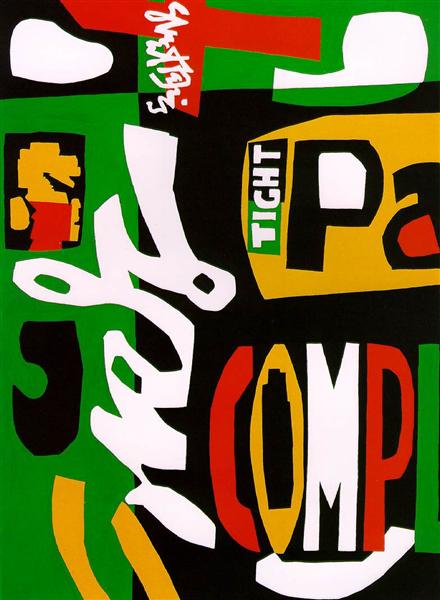
Stuart Davis began as an artist of the Ash Can School, and ended up a father of 1960’s pop art. Pretty good for a dedicated Marxist.

Davis’ trajectory from Ash Can daily life art, often of poverty and the poorer commercial sections of New York City, quickly morphed into a commercial and advertising theme. By 1921’s “Lucky Strike” he was well on his way to critiquing modernity’s affair with stuff and with banal products, a critique that he hoped would sharply point out the basic poverty of capitalism.

It’s worth pointing out that these early collage-like paintings were also a bit cubist, since Stuart was first exposed to Picasso in the famous (or infamous) 1913 Armory Show of modernist art, where his own work was shown.
Then the politics bug bit Davis, and he spent much of his artistic energies in organizing artists into labor blocs during the Great Depression. He was part of the Federal Arts Project of FDR’s Work Projects Administration, and was paid by the government for his murals and other work, a scheme he highly approved of not just for himself but for all his colleagues.

These large, abstract, poster-like statements led him down the path to a jazz fever, and he started painting lively, popular music themes just about the time Joseph McCarthy began looking for “reds” – communists, Marxists – everywhere. There is no sign that Davis was ever directly confronted in hearings, but his earlier critical work was shown less and less, and major institutions began to avoid purchases of his work.
So did he gravitate toward happy, frantic jazz paintings to save his career?
In any case, in an irony of ironies, the CIA began covertly supporting abstract art as a sign of American openness toward new and innovative things, while the Soviet Union was a closed system and only realism – government approved realism – was allowed. So the U.S. government was financially supporting Davis, directly and not so directly, in the 1950’s.
For the first time, Davis, who never cared much for money or painting-for-dollars, was financially secure.
By his death in 1964 at age 71, he was doing things like “Blips and Ifs” below. It’s emblematic of his mature style.
With his late-Beatnik era title, was he catching up to the pop artists? Or was he a father of them?
Ever elusive, ever his own man. A mystery. An ironic one.