pexels jonathan valdes 286676880 30284551

Classical Foreplay vs. Pop Premature Ejaculation

And you thought music was just music.

Sometimes a cigar is just a cigar, Freud may or may not have said. But music is often sex.

martin van maele francion 15
We’re done with foreplay, put down the damn lute.
Music is sex in a gently sublimated form. It’s intellectualized and disguised and sometimes rubbed the wrong way, but all forms of music almost always lead to some kind of climax or resolution.

Even a simple little ditty is a diddly.

61cu+eanw5l. sl1350

Conductor Herbert von Karajan, he of Nazi Party fame and controversy, felt all kinds of things about the stringed armies he led and the music they produced. His best biographer, Richard Osborne, mentions in passing that von Karajan thought that music was sexual, and, beyond a doubt, sensual in nature, not just mere high-class entertainment.

herbert von karajan 1963
Herbert von Karajan, in motion.

American philosopher Allan Bloom, in his magisterial bestseller THE CLOSING OF THE AMERICAN MIND: How Higher Education Has Failed Democracy and Impoverished the Souls of Today’s Students, is even more explicit about sex and music.

71lmvgv7vel. sl1280

” . . . rock music has one appeal only,” Bloom says, “a barbaric appeal, to sexual desire – not love, not eros, but sexual desire undeveloped and untutored.”

How to reach mature love and, indeed, even eros, a refined, elite, patient foreplay?

Bloom prescribes classical music.

internationales management gespräch allan bloom (3x4 cropped)
Allan Bloom, 1989.

Why classical? Because it demands patience, work, time, and trouble. Because it forces listeners to listen attentively or else to fall asleep and fart loudly in a large concert hall. Because classical music tends to really, really build to a climax.

That building, that complex admixture of boredom and excitement, is just like sexual foreplay. Long, fun foreplay, once you have the patience to master and enjoy it.

Herbert von Karajan loved conducting Ravel’s BOLERO because, as Bloom says, it’s the “one piece of classical music that is commonly known and liked (by young people).” But von Karajan didn’t make a steady diet of BOLERO. He didn’t program it everywhere at every time. And Ravel himself disowned and mocked his composition as too simplistic and commercial. Sort of a long pop song.

But von Karajan knew its simple power. The power of seduction.

When a young Roy Orbison, future pop and rock star, was struggling to break out as a power songwriter, unhelped by his looks at a time when looks were becoming all that mattered in pop culture (not talent or ability), his record producer handed him an LP. It was of Ravel’s BOLERO. It may have even been a von Karajan recording.

“Make all your music sound like this,” Orbison’s producer told him. No fool, Roy took the advice.

He promptly started pooping out hit after hit. His songs build magnificently toward climaxes.

The only problem is that they climax after only 2 or 3 or 4 minutes. Usually while you were in the back seat of your father’s ’61 Ford. Hardly conducive to mature, satisfying love.

orbison1987
Roy Orbison, 1987.

“In short,” Allan Bloom says of his students who were untutored in the ways of true love, “life is made into a non-stop (by quickie pop music) commercially prepackaged masturbational fantasy.”

Orbison, who was one of the few rock stars who could have been an opera singer had he so chosen, presumably was happy with his fate. So was Elvis with his hips, the commercially pliable Beatles, and so on.

Today we swim in an overheated pool of come-come-come quickly-quickly-quickly at the speed of light, and not just because of our music choices.

I sense that Bloom is correct. Real eros takes time and patience.

Is it too farfetched to believe that dropping classical music appreciation classes in public schools has made us limp lovers?

pexels jonathan valdes 286676880 30284551
Ole!

images

Kitsch Is For Morons. Sorry.

images

We are prone to saying “to each his own”.

Sorry. Some things are always stupid, shallow, and indicative of people stuck at age 7. If you favor the tasteless, you’re tasteless.

That is, sadly, most of us.

True culture takes a beating every time a new, more naive class enters the marketplace. It used to be that going to college creamed your brain enough that you knew that pink bathrooms and inspirational bumper stickers were somehow what they really are, which is bad. And indicative of really bad taste that made you a moron.

pexels wr heustis 310270240 14602844
graphic cancer

Tomas Kulka, in his Penn State Press book, says that kitsch is any art, music, architecture, or literature – think adult Harry Potter enthusiasts – that emits big emotions (puppies, children, barns, sunsets, waterfalls), easily identifiable subjects (like the prior list), and DOES NOT ENRICH the viewer on any level.

71iljjedz9l. sl1328

What does this do for you?

pexels boxfreelance 30552630
This Is Not Art

What does this say about you?

pexels wwarby 19613731
This says you’re a tasteless moron. And that if it’s in your house, maybe you drink too much.

Kitsch can be old women and men trying to suspend the aging process by applying Scott’s Turf Builder. It can be those metal civic buildings built solely at the lowest possible cost. It can be the color pink. It is anything superficial and easy. Way too easy.

Leave out irony, though. Irony can be high art. Sticking a tasteless plastic pink flamingo out front can be high art if done to confuse your neighbors or chase away gophers. Sticking a pink flamingo out front, if done by Andy Warhol, is an artistic statement of high calibre.

Leave out Susan Sontag’s and Walter Benjamin’s photography. (By the way, if you don’t know these people, you haven’t been to college, you have been to a glorified trade school.) Photography can be high art, just not as most people use it, which is to record every banal daily event, every ingestion, every defecation.

And film can be camp. Campy. The mid-’70’s TV series Kolchak: The Night Stalker, was seen by the masses as a straight horror show. Martin Mull’s Fernwood 2Nite/America 2Nite was seen by some as a “real” talk show. Actually, Kolchak was campy (Monster of the Week!”) and Mull – a great artist, btw – castrated Johnny Carson in broad daylight.

If you want to grow up before you die, buy and read, even if it gives you a cerebral vascular accident, a Philosophy 101 textbook. Or the Bible. Or Saul Bellow’s Henderson the Rain King.

It may hurt. That means it’s worthwhile.

This isn’t worthwhile:

pexels misra denizer 2150450936 31143469
Not worthwhile. Bolstered in its worthlessness by its pinkness. And in its futility.

People now don’t go to college to be schooled in the liberal arts. They go to college to get trained in highly specialized, inane careers. Those careers are stifling.

Thus stifled, those careerists need to recover with trips to Spain, political activism, music from their childhoods, being waited upon like kings and queens in restaurants where the workers get by with the help of marijuana and spitting in the soup, getting massages, binge watching TV, whatever.

And they say, “To each their own!” in defense of their wasted lives. They get away with it because we’ve all been trained since birth that we’re entitled, ENTITLED, to do, have, be, AND LIKE whatever we want. And that our tastes and educational level is on par with Leonard Bernstein.

We’ve been told this lie by the men and women of capitalism who hope to sell us something on the back of their keeping us little narcissistic boys and girls who have to be told by “experts” to stay in our rooms and, as Martin Mull sang in one of his songs, “think the things we thought when we were three.”

Fuck it, most people are a lethal threat to those who aspire to making real meaning. And to having real happiness.

Those who aspire to greatness are part of a remnant. A small and shrinking population of serious people doing and thinking serious things. For the sake of a deep, deep, orgasmic enjoyment.

And having more fun in doing so than any kitsch-dweller can imagine!

pexels peterdanthy 32481980
Losers

81hpeorzkgl. sl1500

Politics Is A Useful Useless Escape From An Inner Void

A sad, internal emptiness fuels most cases of individual political enthusiasm. To belong to a tribe, to take part in a war between alleged good and alleged evil, to be stimulated by outrage, to harden perseverative obsessive repetitive loops in the brain, to have an all-consuming addiction that dulls reality, to have a socially acceptable license to hate, to claim moral superiority, to rationalize envy, to virtue signal, to organize all aspects of life, all make politics a life-saver.

Just not in the way we normally think. Neither “side” solves actual problems. Either side can slowly become evil.

But political involvement saves a person from the problem of how to live as an uncreative soul who presses their nose against the windows of perceived enemies.

81hpeorzkgl. sl1500

THE CULTURAL MARXISM CONSPIRACY by A.J.A. Woods by the Marxist and far-left Verso Press is a tightly researched, not-so-tightly argued book that lays out how the cultural right discovered that the Frankfurt School of philosophy and sociology could handily be used as a baseball bat against the cultural left. Theodor Adorno, Herbert Marcuse, and crew helped Paul Weyrich and William Lind explain how external enemies – these obscure Frankfurt School social critics who were critical of the West – transformed the family-friendly Western Civilization of the 1950’s and turned it into a nightmare of sex, drugs, and rock ‘n’ roll by 1970.

04
family values

CULTURAL MARXISM shows how asinine both sides are. Politics is a high level schoolground fight, a hockey fight, a lot of gritted teeth. So is this book. It’s a book for committed leftists who have a certain set of ideas burned into their brain, wants them reinforced by rebar, and who will fight and argue for them just like a Nazi soldier will fight until death.

pexels polina kovaleva 6185677

Nothing is more boring, useless, and ultimately dangerous than a firmly committed ideologue of any flavor.

pexels ivan s 9643243
feel better now that you’ve made your little sign? how cute! how effective!

The Frankfurt School did not cause the 1960’s. The political right is wrong about that. Woods takes it down handily. The problem is, Adorno and Horkheimer and crew are used as paper tigers to fuel yet another North Korean partisan rant yak-yak-yak for the heavily committed nut cases.

pexels arturoaez225 13520665

The right has their own rants. We don’t want or need rants of any kind.

You may have noticed that boring and repetitive and enraging political posts of all kinds – over and over and over again – on social media have alienated the vast center of politics. They turn off. They watch porn instead, or play video games, or are obsessed with sports and this new thing called FIFA, whatever that is. We no longer listen. That gets us to extremes of socialism or fascism faster than anything.

So why do people do it?

Emptiness. Political activism of any kind is a consumer product. I am what I buy. Until either the next product comes along, or until death breaks the addiction.

Politics was designed to be a compromise. A happy compromise.

Politics, at its best, is people with different ideas sitting around a table – or in a hot tub, or whatever – coming up with compromised solutions to solve complex problems. You know, like solar panels surrounding a nuclear power plant in the same field. Or raising taxes to pay off debt rather than not raising taxes and adding new programs.

But oh, no. Activists have to define what’s left of their lives by extreme positions, and they rationalize that by saying that the “other side” started it.

Madness.

pexels tam le 1175048813 33971674

79703

The Attack of the Breasts

Are the fathers of the Frankfurt School of intellectuals profoundly intelligent and important, or self-important upper-middle class trust fund babies all bloated with turgid and meaningless self-masturbatory road sand for brains?

ADORNO & BENJAMIN: The Complete Correspondence 1928 -1940 proves both are true.

61tnz++wiwl. sl1500

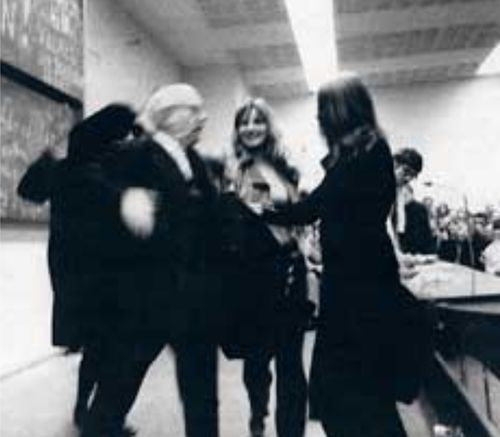
It’s best to start in 1969, after Theordor Adorno called the cops on German student protesters during one of his classes. Shortly thereafter, female students protested Adorno’s protest of the protests by storming his podium, showering him with roses, and then exposing their breasts to him, claiming if Adorno kept teaching then capitalism would never be reformed.

Adorno ran home in shock. He died a few months later of a heart attack.

79703
the classroom breast attack upon Adorno

Aside from not understanding how being showered with bare breasts could be an attack, I have trouble getting the logic here. But people smarter than me tell me that although he spent his life criticizing all aspects of capitalism from a Marxist standpoint, the call to the police and a failure on his part to provide actionable ways to implement leftist reforms were reason to pummel him with breasts.

The letter book from the 1930’s ends when Walter Benjamin, he of massive procrastination, killed himself when he was denied – or at least thought he was being denied – safe passage from France to Spain to Portugal.

walter benjamin vers 1928
Walter Benjamin

The correspondence was a tussle back and forth between two extremely difficult and abstruse personalities, Adorno the Fathead and Walter the Mystical. It was also an intellectual exchange of epic proportions, or else a complete waste of time between two borderline pathologies.

I read it mainly to suss out the historical conditions flying in the background: the fall of the nominally democratic German Weimar Republic, the unleashing of hordes of intellectual refugees upon first France and then England and the United States, and how the allegedly intellectual astute artists and writers and thinkers and musicians felt about it.

The problem is that these were Marxist Light critical theorists. They were mainly of upper-middle class origins. They had money, they had trust funds, and they were more bourgeois and in love with stasis and orderly lives than they were chaos, disorder, war, and, God forbid, revolution.

Thus, they bitched their whole lives about inane capitalist fetishes such as pop music, advertisements, and astrology, but were never ever interested in “solving” these “problems” “for the masses”.

A cute internet myth is the one which claims that Adorno was the real composer of the early Beatles’ songs. Adorno’s “I Wanna Hold Your Hand” and “All Your Lovin'” were done to parody the stupidity of capitalism and its lightweight amusements for imbeciles.

It certainly fits – making money off kids with water on the brain is certainly what capitalism does. But if Adorno was the talent behind the Beatles, it would have made him a hell of a lot more effective in real life than he ever was. And made his estate a hell of a lot richer.

So I recommend ADORNO & BENJAMIN for a sideways glance at the intellectual atmosphere of a very disturbing decade, but good luck trying to figure out their philosophies, because it was designed to be abstruse, on purpose, to keep everybody but these daydreamers out of their private code.

The women who bared their breasts had the right idea. Shock this fathead out of his useless daze by primal means.

adorno women
the protesters

It was the thing he was least able to cope with: something real, something right in front of him, something he didn’t have time to overthink and theorize about.

Adorno’s basic impotence in the face of breasts is not too surprising. He and his wife Gretel, who mothered him, loved the kitschy American TV program “Daktari”. He loved Clarence the One-Eyed Lion. He collected stuffed animals and placed them around his work desks.

By 1969, his students had him well figured out. No revolutionary, him.

484002580 961771666142498 9036095043833098322 n
“Daktari” as work?

imgp0540 copy

When All the Men Wore Hats

I’m trying to figure out Susan Cheever.

I haven’t read her fiction, but I’ve read some of her nonfiction, as you can see from my bookshelf below:

imgp0540 copy
John Cheever, Susan Cheever, and others

She clearly can write. She clearly can think. She has clearly pondered deeply her relationship with her famous father, John Cheever.

But there’s something about her writing and thinking that makes me uncomfortable. It’s an underlying tone. A tone of envy? Regret? Denial? Rage? Sadness? Depression? Longing?

susan cheever 5736916517
Susan Cheever

Imagine having a famous father. A famous father – or mother – of any kind. A race car driver. A movie star. The best local mason or truck driver. It’s an extra load on the psyche of any child.

Then imagine having a famous father as bizarrely complicated as John Cheever, the novelist, short story writer, journal writer, and famous letter writer.

johncheever
John Cheever

But then add to that the fact that John Cheever was an alcoholic, a closeted gay, bisexual, bad with money, poor most of his life, and always deep in various sexual affairs and you have a real stew. Especially when, like Susan, you were (mostly) in the dark about the sexual aspects until he died. His life was so complex yet somehow amusing in a droll way that it even showed up as an element in a “Seinfeld” TV episode.

81uwklperkl. sl1500

“WHEN ALL THE MEN WORE HATS: Susan Cheever on the Stories of John Cheever” is Susan’s attempt to discuss her father with a focus on his actual work, and how the actual work reflected the actual and hidden life stories that were percolating just below the surface of what appeared to be a money-poor version of an upper class – or at least an intellectual – life. And there’s another confounding thing: this intellectual literary genius never even graduated from high school.

It’s a slightly disjointed work. It’s repetitive. It’s sometimes hard to follow when she jumps from fiction to nonfiction.

swimmer
Burt Lancaster in “The Swimmer”, a 1968 movie based upon the John Cheever story “The Swimmer”, swimming and drinking himself across the neighborhood and his life

John Cheever’s greatest story might be “The Swimmer”, which was made into a Burt Lancaster movie and is now a famous cult classic. It’s about an upper class, preppie, old money guy who decides to swim home by way of all his neighbors’ swimming pools on a bright, warm, sunny day in some place like Westchester County.

As the movie goes along, we learn more about Neddy, Lancaster’s character. Most of it not good.

The day starts out jolly. As pool follows pool, and neighbor follows neighbor, it gets darker and colder outside, and we learn that Neddy might have career problems, affairs, marital difficulties, money trouble, and, biggest of all, mental health and alcohol issues.

The day ends with Neddy shivering in a pile of dead late autumn leaves at the front door of his home, which is now as dead and dark and shuttered and abandoned as an old ship wreck. His family is gone, his wife and his four beautiful daughters are gone, his door and life are locked.

Neddy has lost reality. He has had a full mental breakdown.

I think this style of writing is called “magical realism”. It can’t happen in real life, only in a mentally disturbed parallel universe. Even though the story is a masterpiece and is perfect, “The New Yorker” was hesitant to publish it, because it was too unhinged. His editor Bill Maxwell said something to the effect that “it can’t go from summer to autumn in one afternoon”.

John Cheever could convincingly make life go from summer to autumn in one afternoon.

This is what Susan Cheever still has to deal with.

the swimmer poster
“The Swimmer”

pexels maria fernanda perez 1038050 5055063

Do What You Want

I have a good habit of not doing what I don’t want to do. Novelist and short story writer Richard Yates was the same way. Only he crucified the USA and took it down in the process of being free.

602548b6c53536001cefde4b
Richard Yates on his beloved Mazda, toward the end

Yates had emphysema, epilepsy, bouts of mental illness, was an alcoholic, and smoked 5 packs of cigarettes a day. He died in 1992 at the age of 66 during a routine minor procedure. Like hard-living jazzeteer Chet Baker, one wonders how he lived that well that long. If Yates had been a vegetarian jogger, he probably would have been gone of an embolism at 40.

With his habits, what could you do for a living? Why, of course, like everybody else today, he taught. Creative writing. Beats a cubicle at Social Services, right?

He didn’t make much money as a writer until he died. His best novel, REVOLUTIONARY ROAD, was made into a good movie after his death, and people found their way back to the book. It was nominated for the National Book Award in 1961. It went up against J. D. Salinger’s FRANNY AND ZOOEY and the winner, Walker Percy’s THE MOVIEGOER, both tremendous books.

Often described as a sociological novel – ugh – it blisteringly attacked consumerism, class, family life, children, the suburbs, and the inane kind of lives and work that Americans settle for.

pexels yuncaba 15647070
typical Americans

I didn’t understand the novel the first time I read it. When I re-read it again a few days ago, I couldn’t put it down. Perhaps Facebook has trained me in the finer art of discerning what’s wrong with most people. Yates had it figured out before vacuum tubes had disappeared.

pexels maria fernanda perez 1038050 5055063
more typical Americans

His suburb dwellers settle for jobs that they don’t like, commutes that they hate, families that they don’t want, busywork that keeps all this shit buried, mindless business in general, drinking, smoking, oversleeping, undersleeping, fucking neighbors, and avoiding at all costs their creative selves, the latter because being creative in a flowlike sense threatens a loss of control which Americans absolutely can not stand.

pexels pixabay 164558
a holding pen

Americans do this because they do what’s expected of them. Conformity. We may seem more lively today than in Yates’ era, but it’s superficial: tats, blue hair, carrying guns, whatever, it’s just a whacko attention-getting device or bloated lips or burned skin – even politicians show off their Nazi skull and crossbones tats today and the most “progressive” among us dismiss it as nothing.

pexels am83 13027758

All of this is in the name of conformity. Doing what’s expected us us. Being a rebel in the way of our various fragmented tribes online. We have nothing else. Yates thought our culture beneath contempt.

Read REVOLUTIONARY ROAD for a revolution in the way you see, think, and feel.

But you won’t, because it might make you feel bad. Americans who live depleted lives avoid feeling even worse than they already do at all cost. Although they might watch the movie version to see Kate Winslet’s tits. (Is she nude in it? She must be.)

pexels planka 33311435

But despite reading it being mandatory if you’re a rare brave individual, realize that it’s NOT just a shit-list of America’s sociological faults.

It’s a soap opera.

It’s mainly one family’s story of accidental procreation, homemade abortion, plans of escape, dreary work and housework, wives who mow lawns, suburban busybodies (one character reminds me of – was it Mrs. Kravitz?? – a character on “Bewitched”), schmoozing, being polite to people you hate in order to get along, humoring children.

And it will change you in ways you need but do not want.

71ctplhklyl. sl1500
Richard Yates’ REVOLUTIONARY ROAD, set in 1955, published in 1961, and right off the 2026 syllabus

munch friedrich nietzsche, mm.g.00263 02

Brains Detesting the Mob

Modernist intellectuals proclaimed that the masses needed extermination, death by plagues, aborting, and gassing. Why?

pexels davidmcelwee 11677697

Author John Carey says it’s because of universal education that dragged almost everyone upwards toward the “higher classes”.

version 1.0.0

The intellectuals – Virginia Woolf, T.S.Eliot, Jose Ortega y Gasset, H.G.Wells, Aldous Huxley, and many others – felt a sudden need, prompted by Nietzsche’s philosophy of the “great man”, to put some breathing space between themselves and the “semi-educated” mass. They did this by openly advocating the “disappearing” of the common mob that common schools were commonly pumping out.

munch friedrich nietzsche, mm.g.00263 02
Edvard Munch’s sketch of the “heroic” philosopher Nietzsche

The intellectuals also distanced themselves from the proles by making their own writings and thought as difficult and obscure as they possibly could.

Ever wonder why you can’t read Proust?

pexels calil encarnacion 30667006 34923529

It’s not because you’re stupid. It’s because modernist literature and philosophy is designed to be impenetrable. Postmodern – today’s stuff, especially the French thinkers – is even worse.

In other words, intellectuals are proud and vicious and take status and class differences very seriously. Just like HGTV tries to fend off the wrong kind of viewer with their jerky and nauseating camerawork, Adorno wants to drive you away with a migraine.

What was it about the mass of humanity – you, in other words – that the modernist individuals found ghastly?

Your love of canned foods, especially canned fish. Your love of crap food and cheese cheese cheese in general.

pexels polina tankilevitch 4109274
what the dreaded masses like

Your love of, eventually, radio and television and cable TV and streaming and tour groups and cruise ships full of viruses and bad bands.

Got NETFLIX? Of course you do, you moron!

netflix 2015 logo
what morons waste their lives on

They hate that you live in the suburbs, which were already booming at the turn of the 20th century. Your suburbs stole the wooded footpaths within close distance of cities that intellectuals enjoyed trodding upon as they contemplated and calculated how to fend you off.

They hate that you’ve been educated just enough to threaten their social status but not enough to read Proust, even though you – dangerously – have heard of Proust.

They hate organized, professional sports. Why? Because you like organized, professional sports. Because they envy the money pro athletes make that could be better diverted to intellectual research and second homes for intellectuals.

Mainly, they hate seeing you having fun.

pexels robert hernandez villalta 35224 128457
way too much fun

All of this would be okay, I suppose, if, as the back cover of Carey’s book points out, some intellectuals hadn’t championed gas chambers and nuclear bombs for those who weren’t their fans.

I fear mentioning Hitler, but he thought of himself as an intellectual. And since eugenics and Darwin and Nietzsche were in the air at the time, he was in a position to give these things a shot in reality. Right down to exterminating whole classes of humanity and art and using German masses in a meatgrinder. Stalin, the Turks, and others worked this same soil.

Carey’s THE INTELLECTUALS AND THE MASSES is a classic and is eye-opening. Right down to tinned food as a way to mark those for extermination. Is Campbell’s Soup still a thing?

Quick, hide it.

campbell's soup cans by andy warhol
Andy Warhol – certified mass man?

81cmxbkwlwl. sl1500

Holding Yourself Back From Greatness?

Director Terrence Malick’s BADLANDS is one of the greatest movies ever made. His next movie, DAYS OF HEAVEN, is close to great. After 15 years more or less hiding, his third movie, THE THIN RED LINE, is good.

It went downhill from there.

81cmxbkwlwl. sl1500

John Bleasdale’s The Magic Hours makes it clear that Malick’s BADLANDS barely got made. It had a non-union crew, had no decent financing, had trouble getting distribution once it was made, and nearly burned to death one of the crew when a house fire scene went (incompetently) awry. This is the story of an indie film that had Malick begging money from friends, colleagues, and parents.

badlands movie poster

We love these tough stories when they turn out well. BADLANDS turned out well, won awards, has worn fame well, and has gone down in filmmaking history. It established Terrence Malick as a filmmaking genius at a young age. Perhaps to his detriment.

How do you follow up an early act of genius?

tm07
Malick in a cameo scene in BADLANDS

Loosely based upon a real murder spree by a young couple, stars Sissy Spacek, Martin Sheen, and Warren Oates – with Malick as two different minor characters; money was tight – fill out the lushly-shot and atmospheric movie with murderous psychotic and erotic blankness.

pexels brett sayles 10404245

When not randomly killing, they dance to music on a car radio. They plan their future. They dream of Canada or Mexico. They shoot fish. Sheen’s character Kit shoots bounty hunters.

pexels thegenner 17985208

Malick makes violence and murder mindless. Natural. Normal. Psychosis has no boundaries. Being psychotic is a lot like hanging laundry on a clothesline: banal.

And it’s brilliant. Haunting.

DAYS OF HEAVEN is set just before World War I in the plains of Texas. A wealthy wheat farmer brings in trainloads of poor immigrants to act as his peasants. Again, the movie is wonderfully atmospheric – Malick is a master artist – but it’s rather a standard story of love and jealousy and eventual murder.

daysofheavenposter

HEAVEN is a great movie because of its feel and because of the voice-over by young actress Linda Manz. Spacek did a voice-over for BADLANDS, too.

These narrations acted as a kind of crutch for Malick. To his credit, he recognized that and tried to minimize using them in the future. But in his first two movies, wow, they make them really work. Spacek’s unique gravelly voice, and Manz’s even more gravelly 14 year old’s voice, are the things of dreams.

And then THE THIN RED LINE came about 15 years after his two classics. Bleasdale makes it clear that after two difficult acts of genius, Malick may have withdrawn because of the pressure to follow up.

Malick did follow up. Nothing he has done has been bad. But, to me at least, it’s the common story of genius slowly petering out the more and more we expect of it.

I see the same trajectory in novelist Don DeLillo’s career, only without the acts of genius frontloaded like they are with Malick. In DeLillo’s case, WHITE NOISE was a mid-career shooting star. Then he was told that he was brilliant, believed it, and tried too hard to write big-themed novels: the history of garbage in UNDERGROUND and a re-formulation of the JFK assassination in LIBRA.

But we have what we have, some great movies and some great books. We need to accept that not everything can always be perfect, and perfection is seldom repeatable.

Do artists retreat on purpose, to escape impossible expectations? Or is it mere entropy? Or erosion? Or overreaching?

Or, as in HEAVEN, is it . . . locusts, external factors, time and aging alone?

pexels jeffrey czum 254391 3330118
very much the farmer’s house in DAYS OF HEAVEN

pexels ron lach 9893523

Entertainment vs. Art

“Open your mind. Figure out things for yourself.” These are the most frightening sentences to most people.

red room
David Lynch’s Red Room in the various TWIN PEAKS series and movie

Most people either go to school, go to work, or are retired. And then they die.

trinity test
The Trinity test, the first nuclear detonation in history. Hell unleashed in TWIN PEAKS: The Return

These normal people do not want to be challenged when they get home at night. They want to overeat, have some pot or booze, and fall asleep while watching “COLUMBO”, where everything is spelled out clearly and tied with a nice ribbon.

This is called “entertainment”.

Entertainment consists of things you don’t have to think about. The same damned photos. The same food. The same route. Algorithms that all direct the same ads to you. Portaits of horses and doggies and paintings of barns and waterfalls. The same damned symphonies – the “warhorses” – and the same damned Paul McCartney.

And sports. The whole point of sports is that there WILL be a definite conclusion. There WILL be a plot, even though the result will vary. (Sports fans are always disappointed by ties. There’s no conclusion.)

Oh, look! Paul has another album out at 97! Isn’t he amazing! Yankees 7, Mets 2. The murderer was the shifty-eyed guy on “Mannix”. Bach always sounds like the Bach you were “exposed to” – a telling phrase, a damning phrase! – in 4th Grade music class. Yup, that’s my dog. Looks just like him, I’d know him anywhere! Here’s a photo of my family again, yes, I have one! Republicans are the problem, Democrats are the problem, I know, I’m a moron, but this is what I firmly believe, say stuck people.

And there’s nothing wrong with this. We all have to learn, work, and die. We all need to unwind. And we all have to be mindless at times and recite the given script.

However . . .

giantno
The Fireman in TWIN PEAKS, one of the entities who controls the universe. And you.

There is an alternative to eating predigested commercial pablum. It takes effort, not just passive copying, not just comfort food.

You have to WORK with the author or screenwriter or composer or artist, and be uncomfortable while you help “write” the stories in your own mind.

This is the realm of being fully human. This is the realm of true happiness.

And this is the world of abstract art, modern art music or jazz, literary or experimental writing. Things that take work. Things that make you uncomfortable. Things that make you frustrated. Things that make you . . . think.

To think is to be fully human and fully yourself. And happy. Maybe for the first time in your life.

I just read Clarkson University graduate John Thorne’s book, OMINOUS WHOOSH: A Wandering Mind Returns to Twin Peaks.

51y3py4izfl. sl1491

One of the things Mr. Thorne discusses is the notion that “Twin Peaks” fits its scenes and stories (as such) onto film the way most people surf the internet or “doomscroll”. At random. In little bits. In a hashlike-fashion. With static. Very much unlike an overtime goal that decisively wins a game.

Fragmented. Distracted. Moving from one little interesting nub to another. As David Letterman once described, sort of, how he surfed cable TV, “I switch from channel to channel, see a breast, watch awhile, then move on.”

Sometimes the channels tightly cohere. You have reached the shopping channel tier, perhaps, or the weird religions sphere. Everything blurs together, but they’re about the same and tell about the same story, right?

Sometimes, the channels are randomly squashed together. Smug and condescending PBS next to The Gun Channel next to the Look-At-The-Newts-Mating-In-A-Lovely-Spring-Pond nature channel.

Here is a gallery full of my abstract artwork. Notice how it coheres as abstract, yet each individual painting – David Lynch was an abstract artist, mainly a painter, and an abstract filmmaker – is . . . random in its effects:

271183215 10159755532060747 8948259227172787468 n copy
Art by Gregg Fedchak, in a Lynchian red room. Photo via the Frederic Remington Museum. Study group in action.

And here is the other aspect of “Twin Peaks”: it’s not just doomscrolling or breast-scrolling, it’s not just entertainment to kill time, it’s art to fulfill your humanity and to bring you a sniff of happiness – true happiness.

270938082 10159755530745747 1563090405532852767 n copy
Photo by the Frederic Remington Museum. Paintings by Gregg Fedchak

So the various “Twin Peaks” are surfing-like, but not just random. Each “episode” or scene invites you to help make doomscrolling into a lush and verdant field that you have helped plant.

pexels ron lach 9785021

Suddenly, you’re not just a passive consumer of entertainment, but like The Fireman in the photo above. A co-creator of a universe. Your own universe.

Perhaps your universe is disturbing. Perhaps your inner world is a lot like these scurrying “Woodsmen” that Lynch created:

conveniencestore
The evil Lynchian Woodsmen

Get used to your own Red Room.

Creativity. It’s good. Which is why you’ve carefully crafted a banal world of sports and politics and “Columbo”. Because you’re afraid you don’t deserve to be happy?

pexels ron lach 9893523
a Red Room

poster of from the terrace

The Art of Burning Bridges The O’Hara Way

Everybody hated John O’Hara. But he made a good living at it.

I just finished Geoffrey Wolff’s biography of author John O’Hara, and I know less about O’Hara than I did when I started it. Like the previous bio I read, anything about him sucks your brains out your ears and you know less about him than when you or I read him in college.

71umih2edbl. sl1500

Perverse and prolific, O’Hara built, not unlike P.G. Wodehouse did in his many Blandings Castle novels, a cottage industry writing in the same damned fictional world, set in his native Pottsville, PA, thinly disguised as “Gibbsville.”

Looking back at him a half century since his death, you have to wonder why anybody cared.

He was concerned about sex in his small town, and about social class distinctions in small cities, and preppie sports, and Brooks Brothers shirts, and his Rolls Royce, and booze, and Yale, and booze, and booze.

Reading O’Hara today, or reading anything about him, is like opening a crypt and sleeping with your late uncle.

I have no idea what this biographer, Geoffrey Wolff, was trying to do, although he says he was trying to find out the “why” of why John O’Hara was such a perversely tortured creature. But, as he admits at the end , he did no better than others who tried to answer “why”.

So O’Hara is forever an enigma. He’s good for studying an era. It’s hard to believe, but he wrote the books and treatments of early and mid Hollywood blockbusters (and some stinkers).

poster of from the terrace

Let’s let Paul Newman and Joanne Woodward take us out. It seems so long ago.

Because it was.